





For Ghanaian businesses with US dollar exposure, the most important currency question may not be where the cedi is heading, but how much it costs to remove uncertainty from the balance sheet.
For companies that earn in cedis but import, borrow or settle obligations in dollars, every exchange-rate movement can affect margins, cash flow and ultimately the reliability of financial forecasts. Yet many businesses continue to approach foreign-exchange risk primarily through market forecasts rather than through a structured treasury strategy.
That approach can leave companies exposed at precisely the moment protection becomes most valuable.
According to Andrew Arde-Acquah, Manager, Global Markets Sales, Corporate and Investment Banking at Stanbic Bank Ghana, the better approach is to recognise that the objective of treasury is not to predict the currency market perfectly, but to determine which risks the business is prepared to retain and which risks it should transfer.
The executive blind spot
Most management teams have an exchange-rate assumption embedded in their budgets. Far fewer have an explicit strategy for dealing with the uncertainty around that assumption.
The sharper question for a board or finance director is therefore not simply, “Where will the currency trade?” but rather, “How much of next year’s earnings depends entirely on where it settles?”
Businesses that navigate currency cycles effectively are not necessarily those with the most accurate forecasts. They are often the businesses that decide in advance which exposures are strategic, which risks can be transferred and which risks they are deliberately prepared to retain.
The exposure, in numbers
Ghanaian businesses operate in an economy with significant exposure to international trade and foreign currency.
Ghana recorded approximately US$1.35 billion in foreign direct investment inflows in 2023, according to UNCTAD data. China also accounted for approximately 22.5% of Ghana’s total imports in 2023, according to the Ghana Statistical Service.
These figures are not forecasts of the cedi. They are indicators of the scale of international capital and trade exposure running through Ghana’s economy.
For corporate treasurers, the implication is straightforward: foreign-exchange exposure should be identified and managed before the market forces the business to confront it.
Three behaviours that leave businesses exposed
There are three recurring approaches that can quietly increase currency risk.
- Waiting for a better rate: waiting is itself an unhedged market position.
- Confusing a market forecast with a treasury strategy: being right about the direction of the cedi does not necessarily mean the business has managed its exposure effectively.
- Buying protection only after volatility arrives: protection can become more expensive precisely when the need for it becomes most obvious.
The central question is therefore not whether a company can predict the next currency move. It is whether management has decided how much uncertainty it is willing to carry.
Why the timing may be unusually favourable
One of the key arguments in the current environment is the narrowing interest-rate differential between Ghana and the United States.
A forward exchange rate is not simply a prediction of where the cedi will trade in the future. The forward price is influenced substantially by the interest-rate differential between the two currencies.
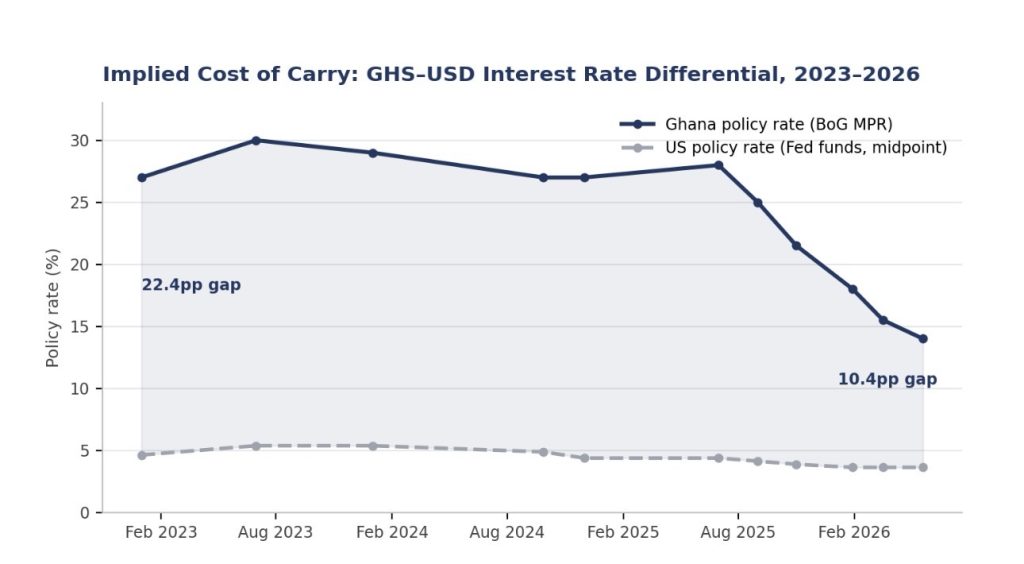
Ghana’s policy rate reached a peak of 30% during the period shown in the accompanying analysis before falling to 14% by 2026. Over the same broad period, the implied Ghana-US interest-rate differential narrowed significantly.
That change matters to corporate treasurers because a narrower interest-rate differential can translate into a smaller forward premium, reducing the cost of locking in future currency requirements.
In simple terms, the price of certainty has fallen.
That creates a potentially important window for companies with predictable dollar obligations to review their hedging policies rather than waiting for another period of currency stress.
Exhibit 1: The cost of carry has narrowed
Editor’s note: The accompanying graph supplied for this article should be inserted here as a separate article image. It illustrates the implied GHS-USD interest-rate differential from 2023 to 2026 and is derived from policy rates rather than representing a quoted forward price.
The graph shows the Ghana-US policy-rate gap falling from roughly the low-20 percentage-point range in 2023 and 2024 to approximately 10 percentage points by 2026.
The significance is not that a narrower differential guarantees a particular exchange-rate outcome. It does not. Rather, the changing differential can alter the economics of forward cover and therefore the price a company pays for certainty.


Why the window may not stay open
The Bank of Ghana maintained its Monetary Policy Rate at 14% following its 131st Monetary Policy Committee meeting in July 2026. The Committee also highlighted renewed external risks to inflation amid heightened global uncertainty.
For corporate treasurers, the significance is the possibility that changing inflation and global risk conditions could eventually alter the interest-rate environment again.
If the differential between Ghanaian and US interest rates widens, the cost associated with forward cover could rise.
That is why a calm market can be precisely the environment in which treasury policies should be reviewed. Waiting for the risk to become obvious may mean waiting until the price of protection has already increased.
The danger of panic buying
Consider a familiar corporate scenario. A business has a dollar payment approaching. The market is calm, the cedi appears relatively stable and management decides to wait for a more favourable rate.
Then an unexpected event occurs: geopolitical tension, a commodity-price shock, a change in global monetary policy or a sudden movement in the cedi.
The company still needs the dollars.
But now the spot rate may have moved and the cost of forward protection may have increased. What was previously a routine treasury decision can become an urgent scramble to contain a financial exposure that has already become more expensive.
Panic buying at the top of a currency spike is not a strategy. It is the cost of having no strategy in place before the spike.
A worked example
Consider a Ghanaian importer with a US$500,000 payment due in 30 days.
For illustration, assume spot is GHS11.63 to the US dollar and the 30-day forward rate is GHS11.70.
If the company locks in the forward rate, the future dollar obligation becomes a known cedi amount of approximately GHS5.85 million.
That number can then be incorporated into the company’s budgeting, pricing and cash-flow planning.
If the cedi subsequently weakens to GHS11.90 per US dollar, the hedge has protected the company’s cost. If the cedi strengthens instead, the company gives up the benefit of purchasing dollars at the more favourable spot rate.

That is the fundamental trade-off.
Hedging is not designed to beat the market. It is designed to remove an unwanted variable from the business-performance equation.
Four questions every board should ask
For boards and senior management teams, the practical test is whether the business can answer four questions clearly:
- How much of our earnings volatility is attributable solely to the cedi?
- Which foreign-exchange exposures are strategic, and which are simply being retained by default?
- Does our treasury policy reflect today’s market conditions, or yesterday’s?
- If the cedi moved 10% tomorrow, would the outcome be planned or would it come as a surprise?
The objective is certainty, not prediction
Currency volatility will return. The uncertainty lies primarily in when and how it returns.
Every company therefore has an FX strategy, whether that strategy has been formally written down or has simply evolved through repeated decisions not to hedge.
The market does not distinguish between the two.
The companies that navigate currency cycles most effectively are those that decide beforehand how much risk they are prepared to retain and how much they are willing to transfer.
For corporate boards, the message is therefore less about predicting the next move in the cedi and more about understanding the cost of leaving that move entirely outside management’s control.
Treasury’s role is not to predict the future. It is to make the future less able to disrupt the business.
In volatile markets, certainty is not a luxury. It can be the difference between reacting to the cycle and leading through it.
Global Markets Executive Insights is a thought-leadership series for corporate leaders, finance executives and Boards, offering strategic insight rather than product promotion.
Andrew Arde-Acquah
Manager, Global Markets Sales
Corporate and Investment Banking
Stanbic Bank Ghana
Research note: The numerical examples in this article are intended for explanatory purposes. The US$500,000 forward-rate example is illustrative and does not constitute a quotation or recommendation to enter into a transaction.
Read more Ghana News, follow Ghana News Live, explore the latest Top Stories, and visit our Policy & Law Hub.