
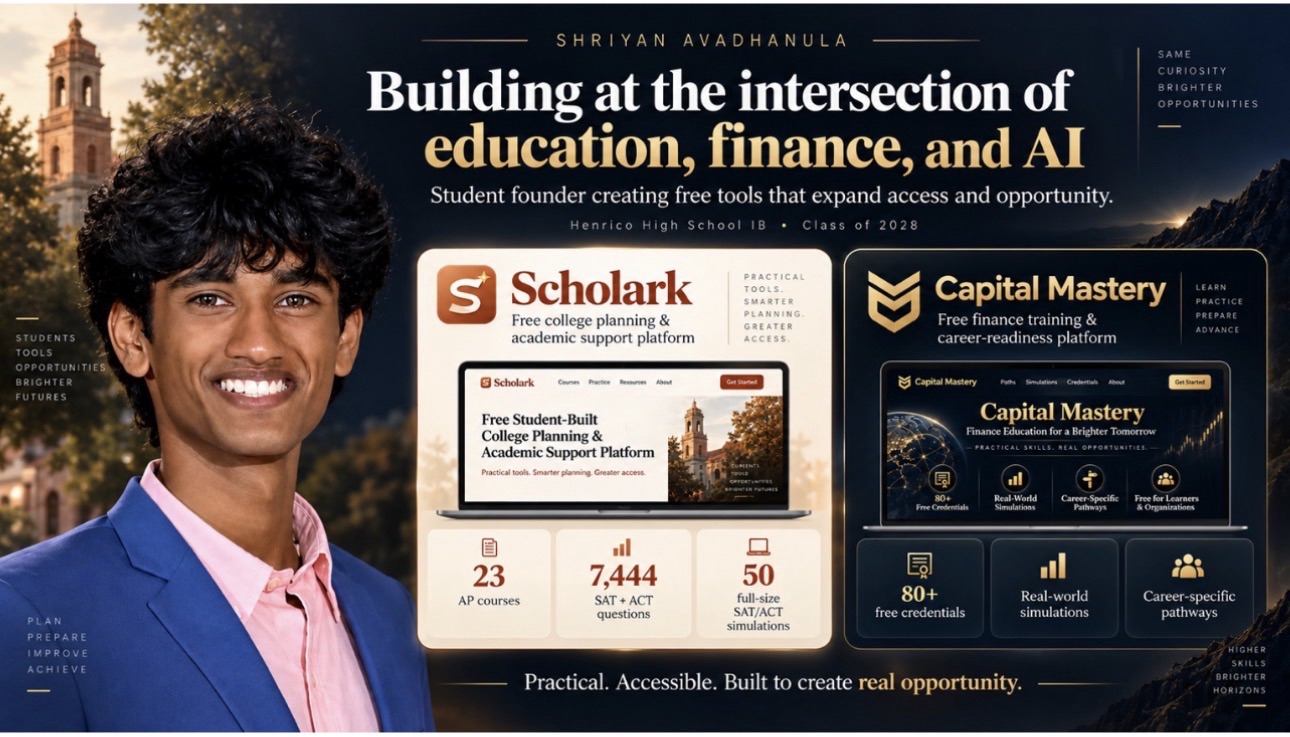
Shriyan Avadhanula is a 16-year-old Virginia high-school student building technology across education, finance, cybersecurity, artificial intelligence, privacy and wearable technology. His projects include Scholark, a free college-planning platform that publicly reports more than 10,000 monthly students; Capital Mastery, a free finance-training and career-readiness platform; DataShadow, a personal-data management prototype connected to a U.S. provisional patent application; and OpenLens, a project focused on researching and testing smart-glasses capabilities.

By Shriyan Avadhanula and Daniel Jeddman
The 16-Year-Old Building Beyond the Classroom
For most 16-year-olds, an 11th-grade school day ends when the final bell rings. For Shriyan Avadhanula, it can be the point at which another working day begins.
The Virginia student has built Scholark, a free college-planning and academic-support platform that publicly reports more than 10,000 monthly students. He has also developed Capital Mastery, a free finance-training and career-readiness platform; created DataShadow, a personal-data management prototype for which he says he filed a U.S. provisional patent application as sole inventor; and worked on OpenLens, a project focused on understanding and testing smart-glasses capabilities.
The projects span education, finance, cybersecurity, artificial intelligence, privacy and wearable technology.
But Avadhanula’s approach is not simply to collect projects. His stated philosophy is to build something when he encounters a problem he believes software can solve.
“If I think about it long enough, I usually end up making my own version.”
Scholark Started With a GPA Problem
The story of Scholark began with something considerably less ambitious than a 10,000-user platform.
Avadhanula wanted a better way to calculate and track his grades. That initial GPA tool gradually expanded. College research followed. Then test preparation. Application planning. Scholarship resources. Essay support. Study planning and other academic tools.
Today, the official Scholark website describes the project as an independent, student-built, non-commercial educational project, rather than an incorporated company or employer. It lists more than 10,000 students monthly and offers calculators, college-comparison tools, SAT/ACT preparation, AP study tools, an essay coach, scholarship resources and application-planning features.
The platform’s central proposition is straightforward: students should be able to access useful academic tools without having to pay to unlock the important parts.
Avadhanula is also candid about what a platform such as Scholark cannot do. He does not describe its admissions tools as guarantees or as replacements for professional counselors. Instead, he sees them as practical tools for students who want to calculate, compare, organize and prepare.
The Economics of Free
There is another question behind Scholark: How does a free platform survive?
Servers cost money. Software requires maintenance. Products require development time.
Avadhanula has kept infrastructure costs relatively low, according to his account, while exploring how the project could eventually become sustainable without abandoning its accessibility.
For now, Scholark’s public description says it is non-commercial and not revenue-generating.
From Education Into Finance
If Scholark began with a student’s frustration over college preparation, Capital Mastery emerged from a different frustration: knowing finance concepts is not necessarily the same as being able to perform finance work.
Avadhanula became particularly interested in investment banking and mergers and acquisitions. He completed finance courses and professional-learning programmes and began examining the difference between learning a concept and actually applying it.
A student might understand comparable-company analysis. That does not automatically mean the student knows which companies should actually be selected.


A student might understand enterprise value. That does not necessarily mean the student can build a valuation, make assumptions, test those assumptions and explain why the conclusion makes sense.
Capital Mastery was designed around that gap.
The Capital Mastery platform describes a free finance-training and career-readiness system covering numerous career paths, including investment banking, private equity, venture capital, corporate development, sales and trading, quantitative finance, FP&A, risk management, wealth management and real estate.
The training model goes beyond conventional lessons. It includes simulations, valuation and modelling exercises, research assignments, spreadsheet-style work, case-based exercises and scenario-driven decision-making.
The platform says it offers 80+ free credentials.
Its public materials also describe an employer-facing layer intended for pre-onboarding, intern training and early-career development.
When a Student-Built Platform Meets a Real Finance Firm
One of the most significant developments came when the project moved beyond Avadhanula’s own computer.
According to the supplied material for this profile, Sterling Point Advisors, a boutique M&A advisory firm, agreed to use Capital Mastery as an in-house training resource for interns. Avadhanula says other firms in the United States are also using or considering the platform.
The significance for Avadhanula is less about the appearance of a polished website and more about whether the system works for people who actually perform the jobs being simulated.
“Once somebody in the industry is actually going to use it for training, you care a lot less about how fancy the platform looks and a lot more about whether it works.”
His own M&A mentorship has reportedly reinforced that principle. A finance professional reviews his analyses and challenges assumptions, comparable-company selections and valuation logic.
Sometimes the answer does not survive the review.
For Avadhanula, that is part of the education.
“When someone who actually does this finds a weakness in your reasoning, you remember it.”
DataShadow: Turning Personal Data Into Something People Can Understand
His next project moves into a much more complicated area: personal data.
People generate enormous amounts of information through searches, purchases, locations, preferences and online activity. Companies can extract value from those signals. But individuals often have limited visibility into how their data is interpreted, what is inferred from it or how it could potentially be valued.
DataShadow is Avadhanula’s attempt to explore what would happen if the individual had more control.
The project’s public documentation describes a local-first functional prototype that allows users to import supported information, configure consent rules, examine derived assets, explore privacy transformations and maintain a local ledger. It also explicitly distinguishes simulated marketplace activity and modeled outcomes from real commercial transactions.
That distinction is central to the project’s design philosophy. A prototype should not present a simulation as if it were an operating market. A hypothetical buyer should not be presented as a real buyer. A modeled financial outcome should not be represented as money that has actually changed hands.
DataShadow’s public documentation explicitly identifies its buyer-demand and monetary-outcome components as synthetic prototype scenarios.
A Patent Filing at 16
According to DataShadow’s public documentation, Shriyan Avadhanula filed a U.S. provisional patent application on August 19, 2026, covering the system’s integrated personal-data asset-management architecture.
The project identifies him as the sole inventor and says the filing was made when he was 16.
Avadhanula also publicly announced the milestone on LinkedIn, describing DataShadow as a working prototype built around the idea that individuals should have greater control over personal data, including how it is accessed, protected and potentially valued.
A provisional patent application should not be confused with an issued patent. The filing establishes an important intellectual-property milestone, but it does not mean a patent has already been granted.
OpenLens and the Smart-Glasses Question
Avadhanula’s interests extend from software into hardware.
OpenLens is presented as an attempt to make the increasingly complicated smart-glasses ecosystem easier to understand.
Smart glasses differ significantly in their hardware. Some have displays. Some do not. Cameras, microphones, sensors, developer access, processing capability and power constraints vary between devices.
A software experience that works on one device may be impossible on another.
OpenLens is designed around research, simulation and benchmarking, with an emphasis on distinguishing manufacturer specifications from simulated behaviour and actual capabilities.
A Bridge From Virginia to Shenzhen
According to the materials supplied for this article, Avadhanula received an invitation from Edison Li of RX Global to attend the 2026 Shenzhen International AI+AR Smart Glasses Industry Expo in China.
The event itself is independently documented by its official organizer. The organizer lists the Shenzhen International AI+AR Smart Glasses Industry Expo for October 27–29, 2026, in Shenzhen, alongside a projected exhibition scale of more than 170,000 visitors and 3,600 exhibitors and brands across concurrent exhibitions.
The invitation itself is based on the supplied correspondence and should therefore be understood as an attributed detail rather than independently established by the event’s public website.
For Avadhanula, however, the significance is straightforward.
A simulator can reproduce a device’s behaviour only to a point. Eventually, developers have to understand the people designing the hardware, the components involved, the optical systems, the engineering constraints and the manufacturers building the products.
“I can build a simulator on my laptop. I can’t simulate the whole industry.”
More Than One Project
There are other projects in the portfolio.
ATHENA, an athlete-intelligence project he co-founded, is described in the supplied materials as having been tested across 27,548 athletes and 155,109 real-world race records.
Scholark’s public biography also lists those figures.
He has also worked on DinkSense, a performance-analytics project for pickleball, a sport he plays competitively.
Another strand of his work is cybersecurity. He produces an annual Cyber Risk Intelligence Report, treating cybersecurity not only as a technical problem but also as a business and financial risk.
The Numbers Tell Only Part of the Story
There are plenty of numbers attached to the story.
More than 10,000 monthly Scholark users. More than 80 Capital Mastery credentials. More than 30 professional-learning credentials and certifications. A provisional patent application. More than 27,000 athletes and 155,000 race records in ATHENA’s reported validation dataset. An invitation connected to a major international smart-glasses exhibition.
But the numbers are not necessarily the most interesting part.
The more consequential question is whether the systems continue to work when people outside the creator’s immediate circle begin testing them.
That is particularly important for a young developer. A project can look impressive when it is controlled by the person who built it. It becomes much more meaningful when students use it, professionals challenge it, organizations train with it or developers depend on it.
Avadhanula understands that distinction.
“I don’t want it to be a list.”
Being 16 Is Not the Product
There is an unavoidable novelty to the story. Ten thousand users sounds different when the creator is 16. So does filing a provisional patent. So does building finance-training software aimed at professionals while still completing high school.
But age has a shelf life.
Next year, Avadhanula will be 17. Eventually, the description “teen founder” will disappear altogether.
What remains will be the products.
Scholark will have to continue serving students. Capital Mastery will have to demonstrate that its training is useful to learners and organizations. DataShadow will have to withstand scrutiny from people with years of experience in privacy, cybersecurity, law and data markets. OpenLens will have to prove that developers and hardware researchers can actually use it.
The projects will have to survive beyond the novelty of their creator’s age.
That is exactly the standard Avadhanula appears to be setting for himself.
“Being 16 might get someone to look once. It can’t be the reason they come back.”
Learning by Building
There is a conventional route to professional qualification: study, credential, experience, then the difficult work.
Avadhanula’s path has been less linear.
He studies something, builds something and discovers the gap between what he thinks he understands and what the real problem demands. Then he returns to the gap.
That cycle appears repeatedly across his projects.
It is also why his finance work has involved mentorship, why his data project explicitly distinguishes simulations from reality and why OpenLens is designed around hardware limitations rather than pretending every device can do everything.
He does not present every project as guaranteed to succeed.
Some will change. Some may fail. Some may become larger than expected.
A provisional patent may never become an issued patent. A free platform may eventually need a different economic model. A prototype may reveal that the original idea needs to be rebuilt.
Those are normal possibilities in technology.
A Collaboration With Daniel Jeddman
The story also has a Ghanaian connection.
Avadhanula has collaborated with Daniel Jeddman, the Ghanaian journalist, publisher and digital creator behind GhanaNews.org & GhanaMedia.net, as part of the development and publication of this profile.


The collaboration reflects a wider connection between the United States and Ghana through technology, media and young innovators building across borders.
For GhanaMedia, Avadhanula’s story is not simply about a teenager who has accumulated an impressive résumé.
It is about what can happen when a young person identifies a problem, builds an initial solution, allows other people to test it and keeps learning from the weaknesses that emerge.
Because starting young is not, by itself, an achievement that guarantees future success.
The more meaningful question is what the additional years can produce.
Avadhanula puts it simply:
“I don’t want starting young to be the accomplishment. I want it to mean I had more time to get better.”
What Comes Next
Somewhere, a student opens Scholark and calculates a grade. Another compares colleges. Another practices for an exam. A finance learner works through a Capital Mastery simulation. A developer examines a smart-glasses capability. A user experiments with DataShadow’s privacy architecture.
Those users may never know who built the tools.
And that, perhaps, is the most practical measure of whether the work succeeds.
The technology does its job. The user gets what they came for.
At 16, Shriyan Avadhanula is still at the beginning of his story.
The platforms are already being built. The users are already arriving. And the harder question — whether these ideas can mature into durable systems that matter beyond their creator — is only beginning.
Contact Shriyan: Gmail | LinkedIn
Follow GhanaMedia on X: @GhanaMedia123
Ghana News | Ghana News Live | Top Stories | Policy & Law Hub