

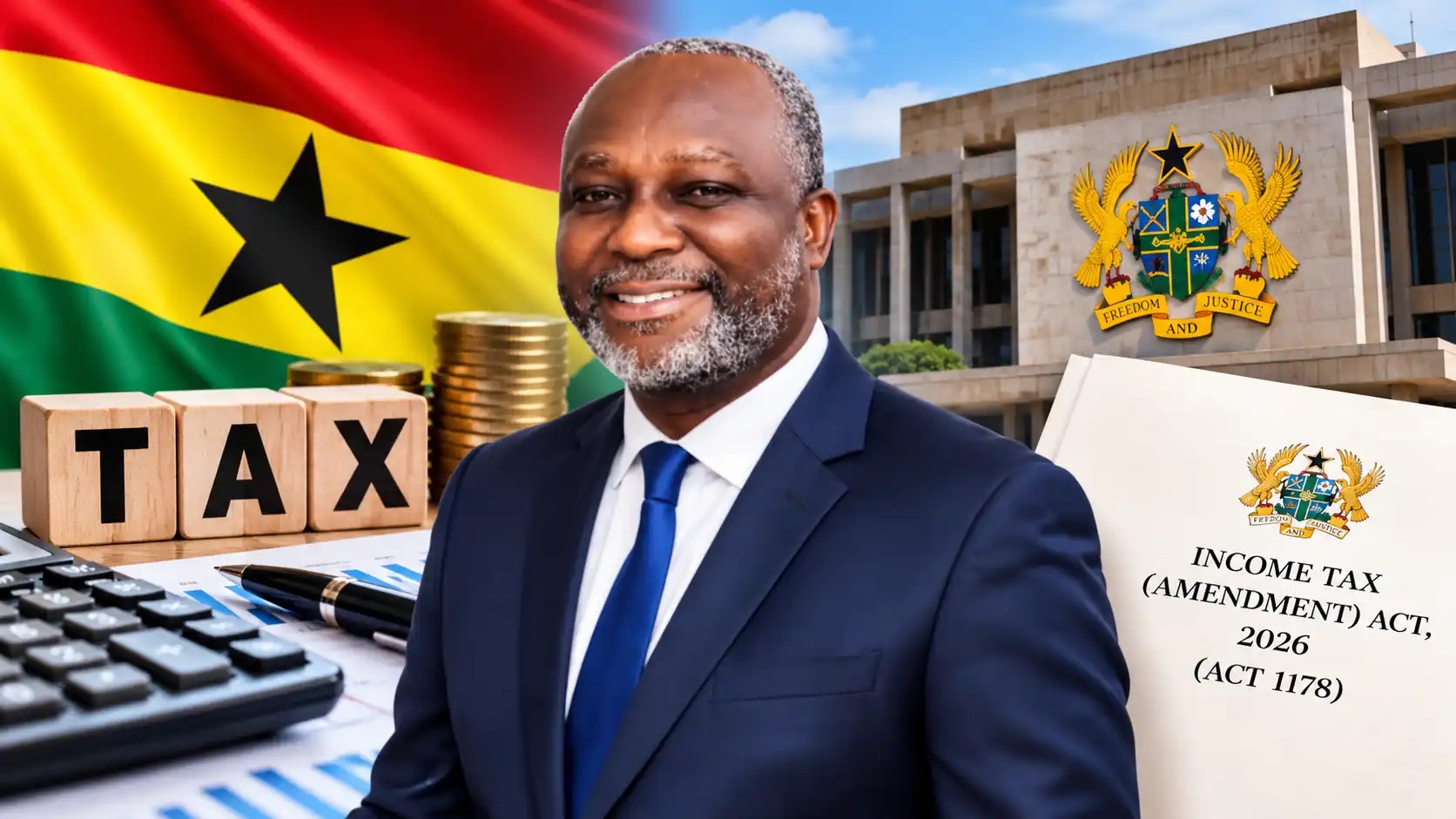
The Income Tax (Amendment) Act, 2026 (Act 1178) introduces important changes to Ghana’s tax system, providing targeted relief to individual taxpayers while expanding access to the presumptive tax regime for small businesses.
The amendment, which was assented to on 26 August 2026, increases the annual tax-free threshold for resident individuals from GH¢5,880 to GH¢7,056 and raises the presumptive tax turnover threshold from GH¢500,000 to GH¢750,000.

According to an analysis by Finance, Supply Chain and Total Rewards Professional Goodnews Dzramedo, the changes could improve disposable income for workers while reducing compliance pressure for qualifying small and medium-sized businesses.
Higher Tax-Free Threshold for Workers
Under the revised structure, the first GH¢7,056 of annual chargeable income for resident individuals is taxed at zero percent. This represents a 20% increase from the previous threshold of GH¢5,880.
The monthly equivalent has therefore increased from GH¢490 to GH¢588. The revised threshold also means minimum wage earners are effectively removed from the personal income tax net, with the change aligned with the 2026 National Daily Minimum Wage of GH¢21.77.
The analysis estimates that every resident individual taxpayer benefits from at least GH¢117.60 in annual tax relief.
New Personal Income Tax Bands
The revised annual chargeable income bands are structured as follows: the first GH¢7,056 is tax-free; the next GH¢960 is taxed at 5%; the next GH¢1,200 at 10%; the next GH¢34,800 at 17.5%; the next GH¢192,000 at 25%; the next GH¢363,984 at 30%; while income exceeding GH¢600,000 remains subject to the 35% top marginal rate.
The 35% marginal rate has therefore been retained, rather than increased. For high-income earners, any available savings arise from the relief provided within the lower tax bands.
What the Changes Mean for Different Income Groups
Lower-income workers earning up to GH¢7,056 annually benefit from the expanded tax-free threshold. For taxpayers earning between GH¢7,057 and GH¢50,000 annually, the analysis indicates that the revised bands can still produce net savings. For example, an employee with annual chargeable income of GH¢40,000 could save approximately GH¢250.
For taxpayers earning between GH¢50,001 and GH¢600,000 annually, the 25% band remains applicable up to GH¢192,000. Estimated annual savings within this broader category range from about GH¢300 to GH¢600, depending on income.
For individuals earning above GH¢600,000 annually, the 35% top marginal rate remains applicable to chargeable income above that threshold.
Small Businesses Get Wider Access to 3% Presumptive Tax
One of the major changes under Act 1178 is the increase in the presumptive tax turnover threshold from GH¢500,000 to GH¢750,000.
Businesses with annual turnover above GH¢20,000 but not exceeding GH¢750,000 may therefore qualify for the simplified 3% turnover-based presumptive tax regime, subject to the applicable requirements.
This means businesses that previously exceeded the GH¢500,000 threshold may now fall within the simplified regime. The change could be particularly relevant to traders, retailers, artisans and small service providers.
How the 3% Presumptive Tax Works
Under the modified cash basis, turnover refers to the money actually received from customers during the year. This can include cash payments, Mobile Money transactions and bank transfers. Sales made on credit are generally counted when payment is received.
For example, a provision shop with annual sales of GH¢100,000 would have a 3% presumptive tax liability of GH¢3,000 for the year.
Similarly, a spare parts dealer with annual sales of GH¢600,000 would now fall within the expanded threshold and, under the example provided, would have a 3% tax liability of GH¢18,000.
Businesses Must Still Keep Proper Records
Despite the simplified nature of the regime, small business operators are expected to maintain proper sales records. Businesses should keep a simple sales book, record transactions regularly, retain receipts and review their annual turnover.
Small businesses with turnover between GH¢20,000 and GH¢750,000 can engage the Ghana Revenue Authority to determine their eligibility for the 3% presumptive tax regime.
Withholding Tax Remains Important
Small businesses supplying companies, schools, hospitals or public institutions should also be aware that withholding tax deductions may still apply.
The analysis identifies applicable withholding rates of 3% for goods, 7.5% for services and 5% for works. These deductions are treated as tax credits rather than an additional tax liability.
For example, where a supplier receives a GH¢10,000 contract for stationery and GH¢300 is withheld, the supplier should retain the withholding tax certificate because the amount can be credited against the business’s tax liability.
Businesses on the 3% presumptive tax regime are therefore advised to keep every withholding tax certificate and submit the relevant certificates when filing their returns. Failure to properly account for withholding tax certificates could result in businesses effectively paying tax twice.
What Employers and SMEs Should Do
Employers should update their PAYE computation tables to reflect the revised First Schedule under Act 1178. Qualifying SMEs should review their annual turnover, strengthen their record-keeping practices and confirm their eligibility for the expanded presumptive tax regime.
The amendment represents a significant adjustment to Ghana’s personal income and small-business taxation framework, with the revised thresholds affecting workers, employers and businesses across the country.
For many small businesses, the increase of the presumptive tax threshold to GH¢750,000 could provide access to a simpler tax framework, while the higher tax-free threshold gives resident individual taxpayers additional relief.
Source: Goodnews Dzramedo’s review of the Income Tax (Amendment) Act, 2026 (Act 1178), including the revised personal income tax bands, presumptive tax threshold and withholding-tax guidance.


